

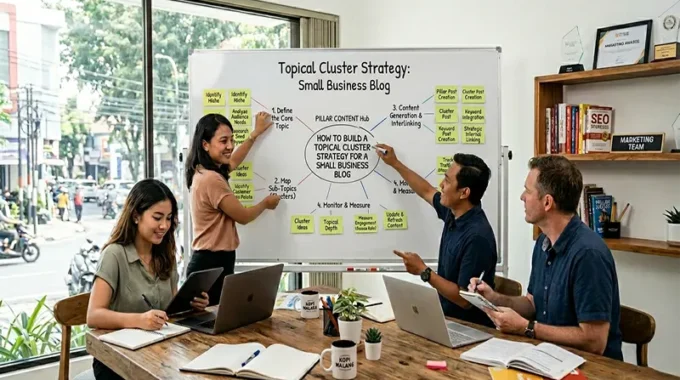
In the SEO landscape of 2026, the era of ranking through high-volume, keyword-stuffed individual posts is effectively over. Google’s algorithms no longer just look for strings of words; they look for Topical Authority. They want to see that your business is an expert source on a subject, not just a site that occasionally happens to mention it.
For a small business, a Topical Cluster Strategy (often called the Hub-and-Spoke model) is the most efficient way to outmaneuver larger competitors with deeper pockets. By building a network of interconnected content, you signal to search engines that you provide a comprehensive answer to a user’s entire problem, which is a massive boost for your E-E-A-T (Experience, Expertise, Authoritativeness, and Trustworthiness) profile.
The Anatomy of a Cluster
To build a cluster, you must move away from “keyword-centric” blogging and toward a “topic-centric” architecture consisting of three core parts:
- The Pillar Page: A long-form, “ultimate guide” page that provides a high-level overview of a broad topic. It should touch on the “what,” “why,” and “how,” serving as the central hub.
- Cluster Content (The Spokes): These are detailed, long-tail blog posts that branch off the pillar page. Each post dives deep into a specific sub-question or “long-tail” keyword associated with the main topic.
- Internal Linking Architecture: This is the glue. The Pillar Page links to every “Spoke” post, and every “Spoke” post links back to the Pillar Page. This internal web tells Google’s crawler exactly how your content relates to one another, cementing your topical expertise.
Step-by-Step Strategy
1. Topic Research: Defining the Core Problem
Identify the “Core Problem” your customers face that is broad enough to support 5–10 sub-topics. For example, if you sell home security systems, your Pillar Page might be “The Ultimate Guide to Modern Home Security,” while your spokes cover “How to choose a smart lock,” “Self-monitored vs. professional systems,” and “Improving security in historic homes.”
2. Content Mapping
Map your topics into a logical tree. Do not write randomly; create a spreadsheet of your Pillar Page and its intended Spoke content. This ensures you aren’t just “blogging,” but building a structured encyclopedia of your services.
3. Execution: Writing for Intent
When writing your spokes, don’t just target a keyword. Answer the specific user intent behind that keyword. If the search is “how to install a smart lock,” your post should be a step-by-step tutorial, not a sales pitch. By providing high-value, non-promotional answers, you build the trust required to eventually convert that reader into a customer.
Scaling and AI Integration
In 2026, you don’t have to guess what your clusters need. AI Content Auditing is now a standard practice. Use AI tools to scan your existing blog and identify “content gaps”—questions your customers are asking that you haven’t yet addressed in a dedicated “spoke” post. AI can also help map the semantic relationship between your posts, suggesting internal links that you might have missed, ensuring your link architecture remains perfectly optimized for search crawlers.
Measuring Success: Ranking by Topic
Stop tracking rankings for one-word keywords. Instead, track “Topic-Level Rank.” Are your Pillar Page and all associated Spoke posts rising in visibility for that specific topic? When you successfully build a cluster, you will notice a “lift” in total traffic for that entire category, as Google begins to reward your site as a credible authority on that subject matter.
Topical Cluster Kickoff Checklist
- [ ] Identify Pillar: Choose one high-value, broad topic that represents your core business.
- [ ] Map Spokes: List at least 5 sub-topics or specific questions your customers ask about that core topic.
- [ ] Internal Link Audit: Ensure every spoke post contains a direct, keyword-optimized link back to the Pillar Page.
- [ ] Cross-Link Spokes: Link relevant spoke posts to one another to further strengthen the topic cluster.
- [ ] Analyze Gaps: Use an AI tool to identify questions your competitors are answering that you aren’t.
Common Mistakes to Avoid:
- Keyword Cannibalization: Ensure your spoke posts don’t compete with the same keywords as your pillar page. The pillar should own the “head” term; the spokes should own the “long-tail” terms.
- Thin Content: Each “spoke” must provide genuine, original value. If it’s just a 300-word fluff piece, it will hurt your authority rather than build it.