

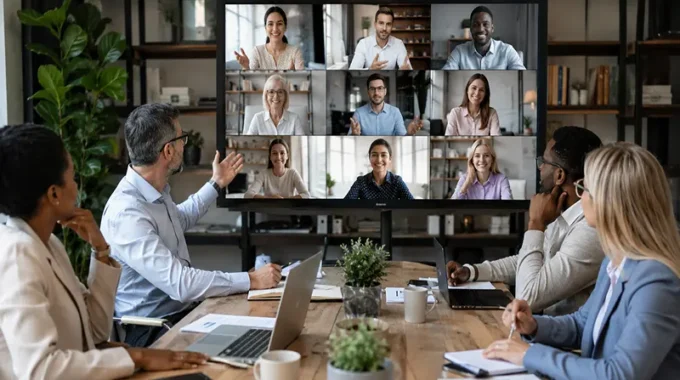
The hybrid workplace is no longer an experiment; it is the standard. However, while the location of work has shifted, many management practices remain stuck in the office-centric era of 2019. Leaders today are grappling with the “Proximity Bias”—the subconscious tendency to favor employees who are physically visible in the office over those working remotely.
To thrive in 2026, organizations must abandon the legacy model of “management by walking around” and replace it with a strategy centered on outcomes, trust, and radical transparency.
The Hybrid Performance Framework
In a distributed environment, you cannot observe the process, so you must obsess over the output. Performance management must shift from monitoring hours clocked to measuring the achievement of clear, agreed-upon goals.
1. Outcome-Based Goal Setting (OKRs)
When you cannot see an employee at their desk, you must clarify what “done” looks like. Objectives and Key Results (OKRs) are the gold standard for hybrid teams.
- The Shift: Instead of measuring activities (e.g., “attended meetings,” “responded to emails”), measure outcomes (e.g., “completed product roadmap milestone X,” “reduced customer churn by 2%”).
- The Result: When expectations are quantified, the location of the worker becomes irrelevant to their performance assessment.
2. The Asynchronous Advantage
Hybrid performance relies on a “digital-first” record of work. By centralizing project tracking in tools like Notion, Jira, or Asana, you create a transparent ledger of progress.
- Documentation as Management: Clear documentation acts as the backbone of performance data. If an employee is consistently updating their project status and hitting milestones, the work speaks for itself. This eliminates the need for status-update meetings, freeing up time for high-value collaboration.
3. High-Frequency, Low-Stakes Feedback
The annual performance review is an relic. In a hybrid setting, you cannot wait six months to correct a course.
- The Strategy: Implement weekly or bi-weekly 15-minute “check-ins.” These are not for status updates—use documentation for that—but for coaching, clearing roadblocks, and ensuring alignment. These frequent touchpoints build psychological safety and keep the manager-employee relationship strong regardless of physical distance.
Managing Performance Fairness
The greatest threat to hybrid culture is the erosion of equity. If office workers are promoted faster than remote workers, your top talent will eventually leave.
Preventing Proximity Bias
Proximity bias is the silent killer of hybrid engagement. To counter it, leaders must intentionally equalize visibility:
- Digital-First Meetings: If even one person is joining a meeting remotely, the entire meeting should be conducted as if everyone is remote. Everyone joins from their own laptop, preventing the “in-room clique” dynamic.
- Standardized Recognition: Ensure that praise and recognition are documented in public channels (like Slack or Teams) rather than shared only in office hallways.
The Shift: Coach, Not Overseer
In a hybrid model, the role of the manager changes from “supervisor” to “resource clearer.”
| Traditional Management | Hybrid Management |
| Focus: Presence and hours | Focus: Clarity and outcomes |
| Feedback: Annual/Bi-annual | Feedback: Weekly/Ongoing |
| Visibility: Direct observation | Visibility: Data and documentation |
| Management Style: Overseer | Management Style: Coach/Enabler |
Managers should focus on one primary question: “What is blocking you from achieving your goals, and how can I remove it?” This shift empowers the employee and builds the trust necessary for remote autonomy.
Hybrid Performance Checklist
- [ ] Documentation Audit: Are all key projects tracked in a shared platform where progress is visible to everyone?
- [ ] Goal Clarity: Does every team member have clear, measurable objectives (OKRs) that are not dependent on where they sit?
- [ ] Meeting Hygiene: Are we practicing “digital-first” meeting etiquette to include remote participants?
- [ ] Feedback Rhythm: Have we scheduled recurring, one-on-one coaching sessions that prioritize development over status reporting?
- [ ] Bias Check: Are we reviewing our promotion and bonus data to ensure there is no statistical gap between office-based and remote staff?
The most effective hybrid performance management strategies are, fundamentally, just better management. The distributed nature of hybrid work simply exposes the flaws in weak leadership—if you can’t manage a remote team, you likely weren’t effectively managing your office team either.
By leaning into outcome-based goals, radical documentation, and frequent coaching, you do more than just manage performance; you build a culture of accountability and trust. Stop tracking attendance and start measuring contribution. When your team knows that their impact is what defines their success, they will perform at their best—no matter where they are in the world.