
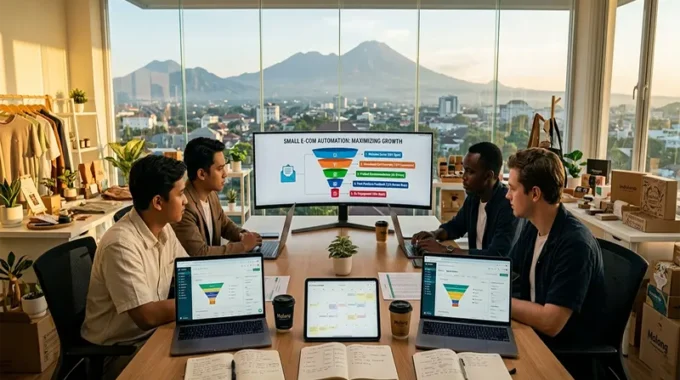
In the 2026 e-commerce landscape, the cost of customer acquisition (CAC) continues to climb, making reliance on paid ads an increasingly risky primary strategy. For the small e-commerce business, the true profit center is no longer found in finding new customers, but in maximizing the lifetime value (CLV) of those you already have.
Email marketing automation is your most efficient tool for this. Unlike social media algorithms that fluctuate, your email list is a direct line to your audience—an asset you own. When you transition from manual, “batch-and-blast” newsletters to behavior-triggered automated “Flows,” you essentially create a 24/7 sales engine that works while you sleep.
The Core Concept: Flows vs. Campaigns
To scale, you must understand the distinction between two types of email:
- Campaigns: One-off emails sent to a list (e.g., product launches, holiday sales).
- Flows: Automated sequences triggered by specific user behaviors (e.g., a welcome email after signing up).
Flows are the “money-makers.” They are highly relevant, personalized, and capture the customer at the exact moment of intent.
The “Must-Have” Automation Stack
If you are just starting, do not try to build a complex system overnight. Focus on these three core pillars, which typically drive the bulk of automated e-commerce revenue.
1. The Welcome Series: Beyond the Coupon
The Welcome Flow is your first impression. Most brands make the mistake of just sending a 10% discount code. By then, the sale is transactional. Instead, build a 3–5 email sequence:
- Email 1: Deliver the discount and set the expectation.
- Email 2: Tell your founder’s story. Why does your brand exist? Humanize the experience.
- Email 3: Provide social proof. Share reviews, user-generated content, or a “Best Sellers” collection.
2. Abandoned Cart & Browse Abandonment
These are your highest-intent customers.
- Abandoned Cart (The 3-Touch Approach):
- Reminder (1 hour later): “Did you forget something?”
- Incentive (12 hours later): Offer a small discount or free shipping.
- Urgency (24 hours later): “Your cart is about to expire.”
- Browse Abandonment: If someone viewed a product but didn’t add it to their cart, send a “Still thinking about it?” email. It’s a lower-pressure nudge that often converts high-intent shoppers.
3. Post-Purchase & Loyalty
The sale is just the beginning.
- Thank You/Utility: Send a confirmation email that includes helpful tips or a “how-to” guide for the product.
- The Review Request: Time this to arrive shortly after the product has been delivered.
- Win-Back: If a customer hasn’t purchased in 90 days, trigger a “We miss you” email with a re-engagement offer.
Key Performance Indicators (KPIs)
To optimize these flows, you must track their performance. Aim for these industry benchmarks:
| Email Flow | Typical Open Rate | Typical Conversion Rate |
| Welcome Series | 40–50% | 5–8% |
| Abandoned Cart | 35–45% | 10–15% |
| Post-Purchase | 30–40% | 2–4% |
Segmentation: Moving Beyond “Batch and Blast”
Personalization is the key to deliverability in 2026. Avoid sending every email to your entire list. Segment your subscribers by:
- Purchase History: Don’t send a “First Purchase” discount to a VIP who buys monthly.
- Engagement: If a user hasn’t opened an email in 6 months, suppress them. Sending to unengaged users hurts your domain reputation, causing your emails to land in the “Promotions” or “Spam” folder for your active customers.
Deliverability & AI Integration
In 2026, technical compliance is vital. Ensure your domain is authenticated with SPF, DKIM, and DMARC records; without these, major providers like Gmail and Yahoo will block your traffic.
Furthermore, leverage AI-driven personalization. Modern platforms now allow for:
- Send-Time Optimization: AI predicts when each individual user is most likely to open their inbox and delivers the email at that exact moment.
- Dynamic Content: AI can insert personalized product recommendations based on a user’s previous browsing history, making each email feel uniquely tailored to the recipient.
Scalability Checklist: Implementation
- [ ] Audit: Do I have a list of all current automation flows? Are they active?
- [ ] Authentication: Are my SPF, DKIM, and DMARC settings verified?
- [ ] Content Refresh: Have I reviewed my Welcome Flow copy in the last 6 months?
- [ ] Cleanup: Have I suppressed unengaged subscribers (those who haven’t opened in 6+ months)?
- [ ] Test: Have I clicked every link in my automated flows to ensure they land on the correct product pages?
Email automation is the most “set-it-and-forget-it” revenue channel in your business, but it requires a “set-it-and-optimize-it” mindset. You don’t need a massive team or a huge budget to compete with big brands—you just need a system that treats your customers as individuals. Start by optimizing your Welcome Series this week; it is the most critical flow for converting casual window shoppers into lifelong brand advocates.