
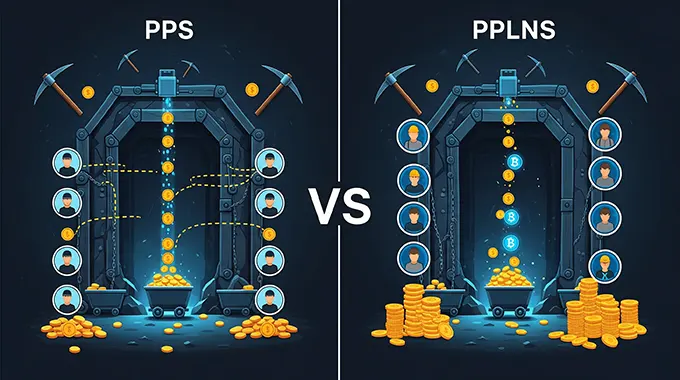
Mining Bitcoin and other cryptocurrencies as a solo miner can be challenging due to increasing network difficulty and competition. As a result, many miners join mining pools, which combine computational power to increase the chances of earning block rewards. However, not all mining pools reward their participants equally — the payout schemes differ significantly and can impact miners’ profits and income stability. Two of the most popular payout methods are PPS (Pay Per Share) and PPLNS (Pay Per Last N Shares). This article compares these payout schemes to help miners decide which is better suited for their needs.
What Is PPS (Pay Per Share)?
Pay Per Share (PPS) is a straightforward payout method where miners receive a fixed reward for each valid share they submit, regardless of whether the pool finds a block. Essentially, miners are paid a predetermined amount based on the expected value of the shares submitted.
Pros of PPS:
- Immediate and consistent payouts: Miners get paid instantly and regularly, providing predictable income.
- Lower risk: Payouts are guaranteed even if the pool experiences a dry spell without finding blocks.
- Simplicity: Easy to understand and track earnings.
Cons of PPS:
- Higher pool fees: Pool operators take on more risk by paying miners regardless of block discovery, so fees tend to be higher (often 3-4%).
- Lower long-term rewards: Miners might earn less compared to other methods during good luck streaks in block finding.
What Is PPLNS (Pay Per Last N Shares)?
Pay Per Last N Shares (PPLNS) rewards miners based on the number of valid shares they have submitted within the last “N” shares before a block is found. Unlike PPS, payouts depend on actual block discoveries and the miner’s contribution to the pool’s work over recent shares.
Pros of PPLNS:
- Potential for higher payouts: During periods of frequent block discovery, miners may earn more.
- Lower fees: Pool fees are generally lower than PPS, as risk is shared among miners.
- Encourages loyalty: Miners who stay with the same pool benefit more, as payout depends on the recent share submissions.
Cons of PPLNS:
- Variable payouts: Income can fluctuate significantly due to luck and block discovery timing.
- Latency risk: Miners who join or leave the pool frequently may receive lower payouts or none for recent shares.
- More complex to understand and predict earnings.
Side-by-Side Comparison
| Feature | PPS (Pay Per Share) | PPLNS (Pay Per Last N Shares) |
| Payout Frequency | Immediate, per share submitted | After each block discovery |
| Income Stability | Stable, predictable | Variable, depends on luck |
| Risk to Miner | Low | Medium to high |
| Pool Fees | Generally higher (3-4%) | Lower (1-2%) |
| Reward Potential | Fixed, consistent | Higher during good luck periods |
| Ideal for | Miners seeking steady income | Miners comfortable with fluctuation |
| Complexity | Simple payments | Requires understanding of share history |
Which One Should You Choose?
- Choose PPS if:
You’re a small-scale or risk-averse miner who prefers consistent, predictable payouts without worrying about block discovery luck. - Choose PPLNS if:
You can tolerate variable income and want to maximize your potential earnings over time, especially if you plan to mine consistently with the same pool.
Understanding the difference between PPS and PPLNS payout schemes is essential for miners aiming to optimize their mining rewards. PPS provides immediate, stable earnings at the cost of higher fees, while PPLNS offers the possibility of greater profits with more payout variability. Assess your risk tolerance, mining scale, and income preferences to select the payout scheme that best suits your mining strategy.